Admin panels for any backend, set up by your agent.
Your agent reads your API, your code, or both, and writes one typed config. No spec required, no backend changes, any login.
claude mcp add admigo -- npx -y admigo mcp{ "mcpServers": { "admigo": { "command": "npx", "args": ["-y", "admigo", "mcp"] } } }codex mcp add admigo -- npx -y admigo mcpnpx admigo initnpx -y admigo mcpthen say: add an admin for this project
In active development — the first release is coming.
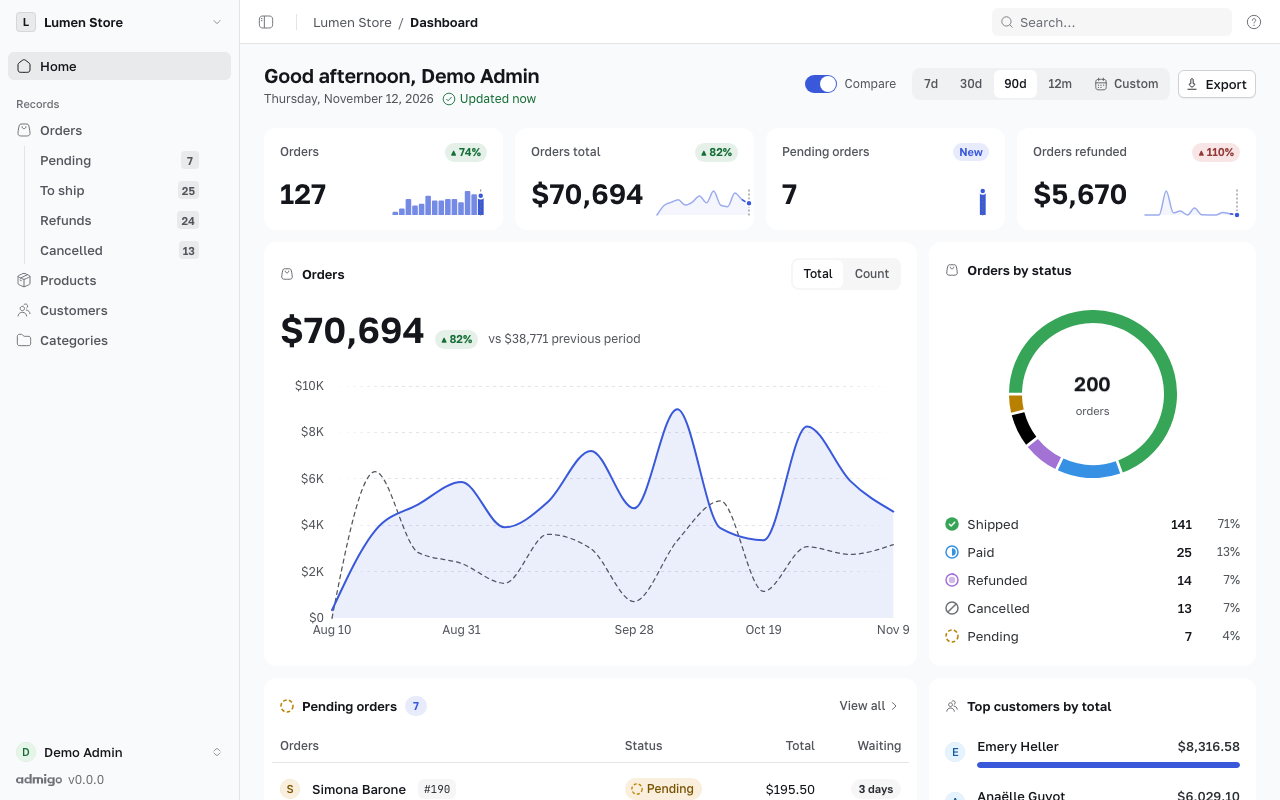
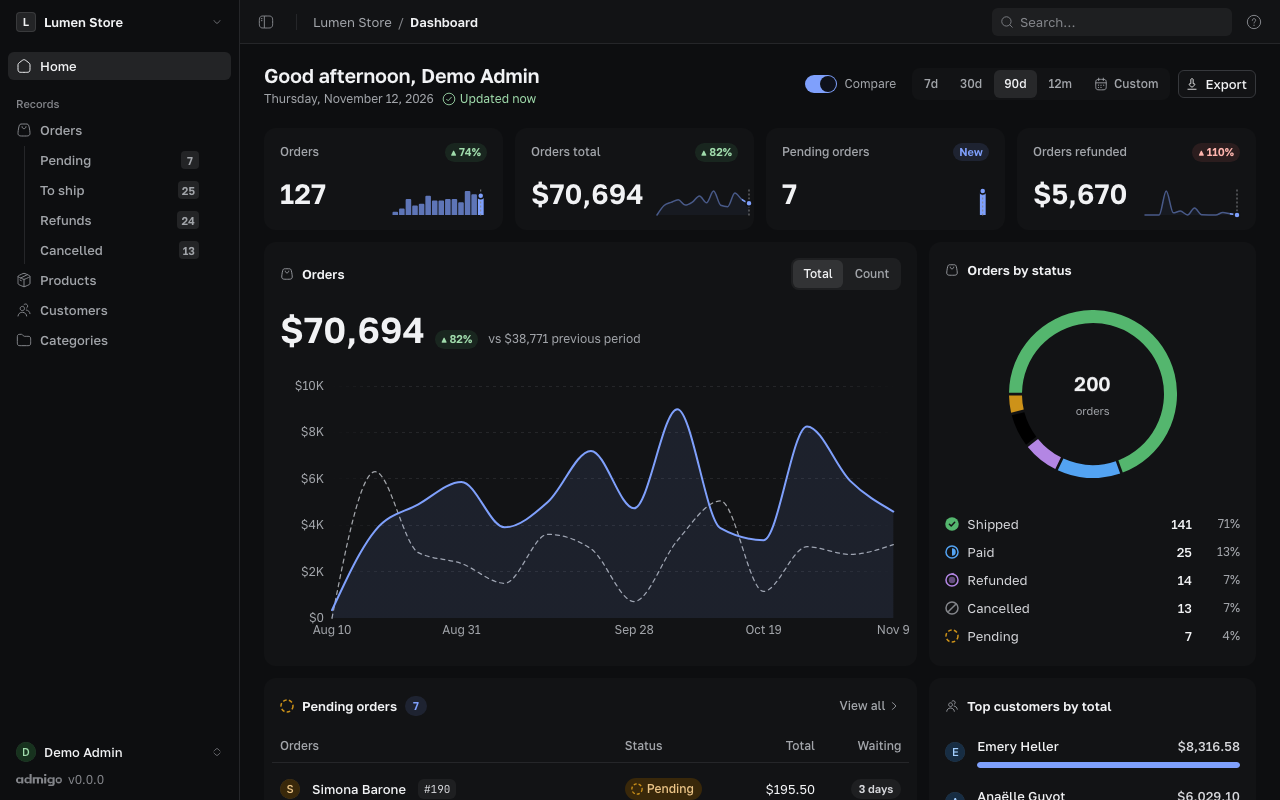
admigo validate checks every config.Why Admigo
Not from scratch every time
Your agent assembles tables, filters, pagination and login from tested parts instead of writing them again. See what that saves
On top of what you have
Any backend and any login, with or without a spec. Admigo never changes your backend; it only advises.
Looks designed, not generated
shadcn/ui and ReUI used in full: loading skeletons, finished tables and filters, light and dark themes.
Your agent works with your users' permissions
Your agent reads data with your users' permissions. Changes wait for a person to approve them, and every request is marked for your audit log.
One typed config, changed by talking
admigo validatechecks every change. The code is yours: plain React and TypeScript.
Friendly with any backend.
Admigo adapts to the API you already have. Your agent picks whatever source it can read, and the result is the same typed config.
How it learns your API
- A spec
- OpenAPI · GraphQL · PostgREST
- origin: "openapi"
- Your backend code
- models, routes, validation rules
- origin: "code"
- Live requests
- the agent calls your API and reads what comes back
- origin: "probe"
- By hand
- write or adjust any resource yourself
- origin: "manual"
Generation stays the default. For OpenAPI it uses Orval: types, zod schemas and MSW mocks. Prefer no build step? Live mode reads a public OpenAPI spec at startup, with nothing to generate.
How people sign in
- Cookie session
- Bearer token or JWT
- OIDC
- HTTP Basic
- API key
- Your own
AuthMechanism
Admigo never changes your backend. When something is missing, admigo doctor tells you what and how to add it.
Laravel, Django, Rails, FastAPI, NestJS, Go, Supabase, Hasura … or your own
Built on your favourite stack
The admin your agent installs is plain React, TypeScript and Tailwind on TanStack. It is code you already know, and yours to change.
Change it by talking
Proof
A fresh agent gets one prompt and an example backend. We record how long the setup takes and how much a person has to fix by hand.
| Example | Time | Tokens | Manual edits | Agent | Date |
|---|---|---|---|---|---|
| LumenStore · Laravelplaceholder — test not run yet | — | — | — | — | — |
| Lumen without Admigothe agent builds the admin from scratchplaceholder — test not run yet | — | — | — | — | — |
| Savedplaceholder — test not run yet | — | — | — | ||
| TeamflowSaaS · Supabaseplaceholder — test not run yet | — | — | — | — | — |
| FleetwatchLogistics · FastAPI + GraphQLplaceholder — test not run yet | — | — | — | — | — |
Principles
MIT licensed
The license covers the whole project.
No telemetry
The Admigo package sends nothing anywhere.
Stable 1.0 API
Breaking changes wait for a major version.
Latest version only
Fixes land in the current release, and upgrading is the support path.
Support in GitHub Discussions
Questions and answers stay public, where the next person can find them.
What's new
0.3.0placeholder
Placeholder entry. Real release notes appear here once the first version ships.
0.2.0placeholder
Placeholder entry. Real release notes appear here once the first version ships.
0.1.0placeholder
Placeholder entry. Real release notes appear here once the first version ships.